
Knowing Your Role
Lynn Kindred

Dr. Lynn Kindred and his wife, Ann, had a memorable dinner one night around 30 years ago. It wasn’t the food or the restaurant that makes the memory seem like it happened last week. It’s what happened when they arrived home.
When they walked in the house, Ann went to retrieve the phone messages and quickly called Lynn to the answering machine. “You won’t believe who left a message on the phone,” she told him.

The deep voice on the other end of the phone said, “Hey Lynn, you probably don’t remember me, but we played basketball together. This is Wilt Chamberlain. I was wondering if you would give me a call.”
“I said to Ann, ‘Do we know some guy named Wilt Chamberlain?’” Kindred joked recently.
Chamberlain had been diagnosed with atrial fibrillation. Since Kindred was a cardiologist, Chamberlain wanted some advice. Kindred told him to send him his medical information, but “the big dipper” never sent anything. When Chamberlain died a couple of years later, Kindred wondered if maybe he could have helped his former teammate had he sent him the information.
Kindred and Chamberlain arrived in Lawrence at the same time, under drastically different expectations. Chamberlain came from Philadelphia as the nation’s biggest recruit, literally and figuratively. Kindred came from Emporia, Kan., where he was the leading scorer on his high school basketball team.
“I had a good career in high school,” Kindred said. “I had an 18-point scoring average. I was fast enough that I could play pretty well. But Coach Phog Allen needed people who could make good grades. That may have been the biggest reason I was recruited.”
Kindred said that he and Chamberlain had different agendas at Kansas.
“I was going to KU for school, and he had more fun than I did,” he said. “I knew my career wasn’t going to be in basketball and his wasn’t going to be in medicine.”
Freshmen were not eligible in that era, but Chamberlain scored 42 points in the freshmen-versus-varsity contest. As a sophomore, he set individual game records at KU in points (52) and rebounds (31) in his first collegiate game.
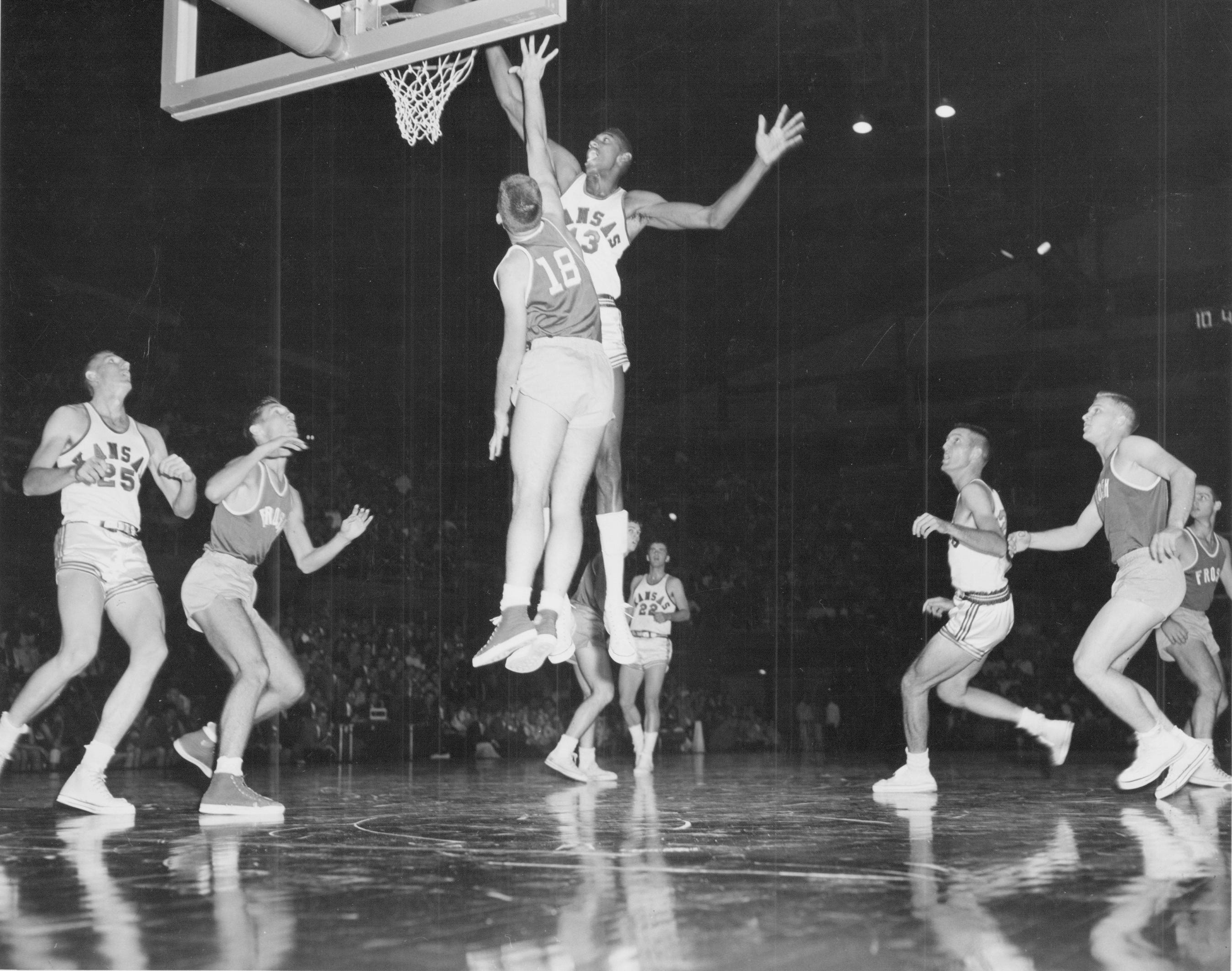
Chamberlain and Kindred played together for two years at Kansas, but it had been about 40 years since they shared a locker room. Kindred could have been forgiven if he didn’t remember his former teammate in all that time. After all, Chamberlain hadn’t really done much worth remembering since his days at Kansas.
All he did was become the only player in NBA history to average 30-plus points and 20-plus rebounds in a season, something he did seven times...and for his entire 14-year career (30.1 points and 22.9 rebounds per game). He scored 43 points and grabbed 28 rebounds in his NBA debut.
All he did was make 13 All-Star teams and earn four NBA MVPs. All he did was set 72 NBA records, most of which he still holds by himself. Among his records are several that are considered unbreakable, such as averaging 22.9 rebounds for a career or 50.4 points per game in a season, scoring 100 points or grabbing 55 rebounds in single games, and scoring 65 or more points 15 times and 50 or more points 118 times.
During Chamberlain’s time, defensive statistics like blocks and steals were not recorded yet. According to team statisticians who kept track with the Philadelphia Warriors in Chamberlain’s days with the team, he had as many as 25 blocks in one game. The official NBA record for blocks in a game is 17.
So why would Kindred remember that guy? Maybe the 1957 national championship game in their sophomore year could trigger a memory.
Kansas rolled through the 1956-57 Big Seven Conference at 11-1 and entered the NCAA tournament with a 21-2 record. The Jayhawks won their first two games in the tournament against SMU and Oklahoma City, advancing to the Final Four in nearby Kansas City.
In the semifinals, they defeated two-time defending champion San Francisco 80-56 to advance to the title game the next night against North Carolina. The Tar Heels came into the title game at 31-0 and ranked No. 1. They defeated Michigan State in triple-overtime the night before—there was no day off back then—and they were a confident group despite likely fatigue.
“It didn’t bother us that people said Kansas was a big favorite,” North Carolina star Lennie Rosenbluth told me a few years ago. “We didn’t play well against Michigan State. It wasn’t that we were looking forward to the next game; we just didn’t play well.
“Kansas had to figure out there was some reason we were undefeated. We only played eight games at home and 24 away from home that season. They had to figure that we were a halfway decent team.”
Though Rosenbluth didn’t necessarily agree that Kansas would have been unstoppable with a shot clock, he did agree that stopping Chamberlain was the key.
“Coach (Frank McGuire) told us in the locker room that Kansas couldn’t beat us, but Chamberlain could,” he said. “We had to be very conscious of where Chamberlain was at all times. We played a 2-3 zone against them, and we had most of our men on Chamberlain. There was always someone in front of Chamberlain and someone on the side to stop them from throwing the ball into him.”
Both teams played the title game methodically. North Carolina was hot in the first half, taking a 29-22 lead at halftime. The play was slower in the second half, and with no shot clock, regulation ended with the score tied at 46-all. Each team scored 2 points in the first overtime and the second overtime was scoreless. The third overtime saw Kansas take a 52-51 lead into the final minute. With a few seconds left, North Carolina center Joe Quigg drove to the hoop and was fouled.
“Coach McGuire called timeout,” Rosenbluth remembered. “Usually the other team calls timeout to ice the shooter. But Coach called the timeout and told us what we were going to do after Joe made the two foul shots. Joe just said, ‘I’m ready coach.’”
Quigg calmly stepped to the line in front of about 12,000 screaming fans—only about 100 of them were for Carolina. Holding an NCAA championship and an undefeated season on his shoulders, he made both foul shots and Kansas called timeout.
Everybody in the auditorium knew where the ball was going to go. Kansas tried to throw the ball to Chamberlain, but it was intercepted by Tommy Kearns, who threw the ball up into the rafters as the clock expired.
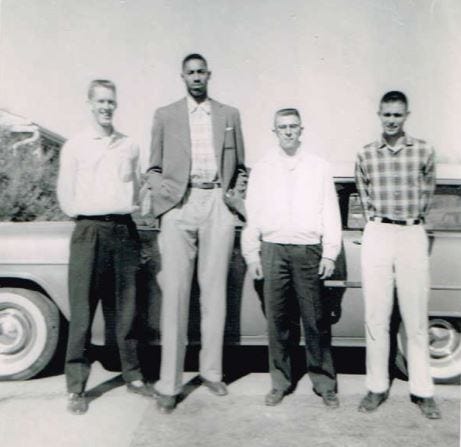
Although he was probably the second or third man off the bench in most games, Kindred did not play a second in the championship game. He knows the result would have been different if he had.
“We would have gotten beat by 10 points in regulation had I played,” he joked.
He’s not one of those former athletes who thinks, “The older I get, the better I was.”
Kindred’s career exploits were not as glamorous as Chamberlain’s, though he did tell me recently that he and Chamberlain were the only two-sport letterwinners at the university in the 1957-58 school year. Chamberlain also excelled in several events for the track team. Kindred lettered in basketball and golf.
But Kindred was not at Kansas just to play sports. After graduating, he excelled as a cardiologist for more than 50 years. He and another cardiologist opened a medical practice in 1971 that grew to 20 doctors before they sold it to the University of Kansas Hospital in 2000. Kindred retired in 2020, but that practice now has more than 50 doctors.
Still, he reminisces about what might have been on the basketball court.
“I think I could have played in today’s game,” he said. “I was pretty fast. I was a good defender. I probably wouldn’t have scored a lot of points, but I would have been a pretty good seventh or eighth man.
“I hope I could have played, but I don’t know for sure.”
Then he paused. “There’s no way to prove it...so maybe I would have been an All-American.”
In a much more important way than just playing hoops, he has been.